EDPB anonymisation — three tests
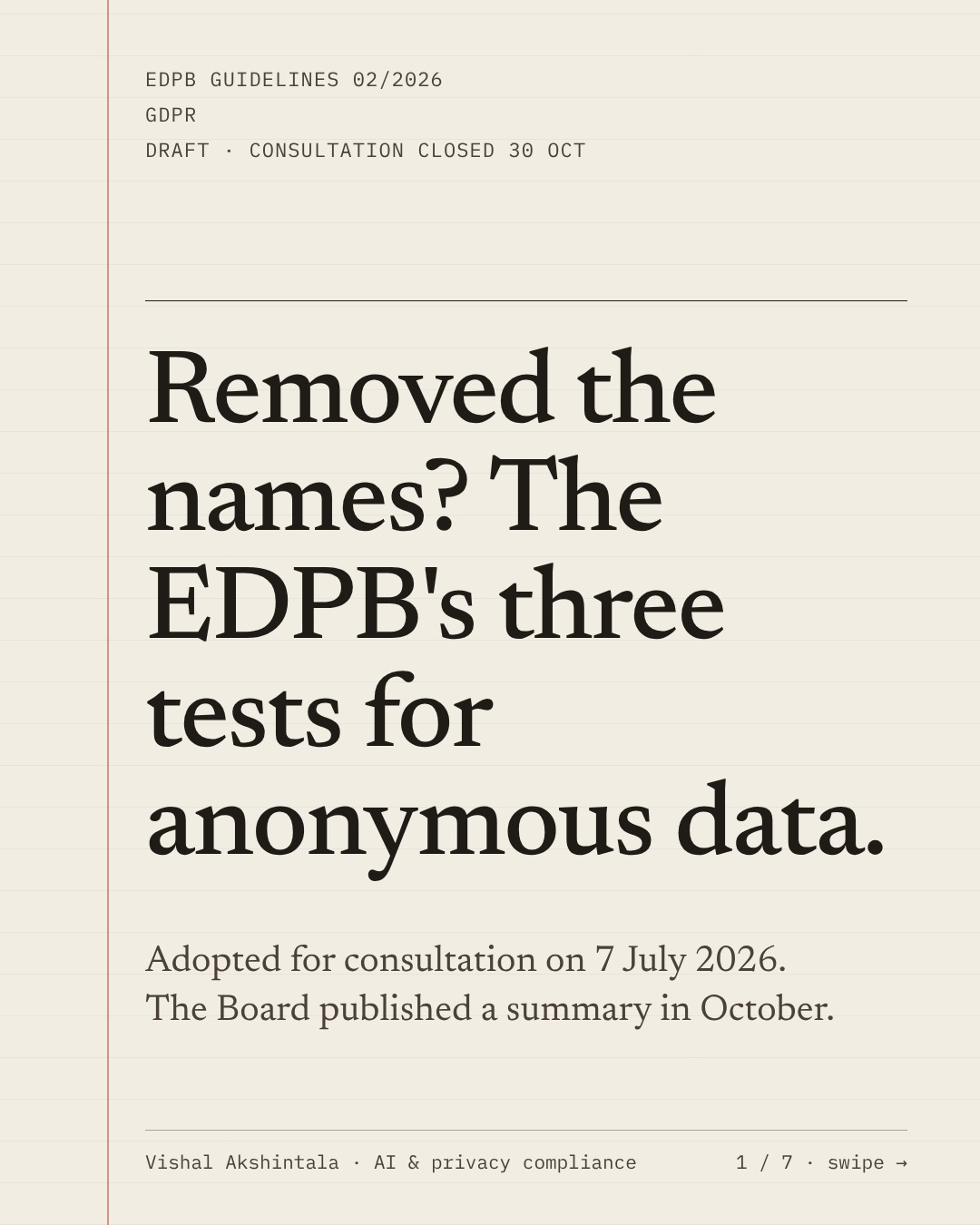
Deleting the names column does not make a dataset anonymous. The European Data Protection Board has set out three tests that it should pass.
The EDPB's draft Guidelines 02/2026 on anonymisation were adopted on 7 July 2026, and the public consultation closed on 30 October. In October the Board also published a short summary of how to assess anonymity under the GDPR.
Two points stand out to me. First, anonymity is relative: the same data can be anonymous for one company and personal data for another, depending on who could re-identify it and by what means. Second, the test looks at the means a party is reasonably likely to use, including help it could easily hire.
If your team shares "anonymised" data with partners, vendors or AI developers, this is the framework the EU's data protection authorities have proposed for checking that label. The guidelines are still a draft, so the final text may change.
It depends on who holds the data
- The EDPB: data is anonymous for a particular entity if it does not relate to an identified or identifiable person.
- So the same dataset can be anonymous for one company and personal data for another.
The three tests
- No record isolation: no unique combination of values points to a single person.
- No linkage: no record can be linked to the same person's record in another dataset.
- No inference: no specific and meaningful conclusion about a person can be drawn.
- All three met: the data can be considered anonymous. If not, more analysis is needed.
Count the help they could hire
- The test is the means reasonably likely to be used. In the EDPB's example, a partner that cannot re-identify data itself, but could easily hire someone who can, has those means.
- If you are likely to pass data to a party that can re-identify it, it may become personal data for you too.
Contextual or simplified:
- contextual: looks at each entity's real means; reflects the full legal standard, but needs detailed information;
- simplified: asks whether re-identification is reasonably likely in the abstract; it can show data is anonymous, but cannot prove that it is not.
- EDPB summary, October 2026
Five steps from the EDPB
- Describe the data, where it is stored and what could help re-identify it.
- Rule out the obvious: emails or phone numbers mean it is not anonymous.
- Identify who could hold it and the means they are reasonably likely to use.
- Choose the simplified or the contextual approach.
- Test record isolation, linkage and inference.
See the full carousel on Instagram.
Sources
- https://www.edpb.europa.eu/news/edpb-sheds-light-on-anonymisation-and-web-scraping-for-generative-ai-and-adopts-final-version_en
- https://www.edpb.europa.eu/system/files/2026-10/edpb-summary-102026-anonymisation_en.pdf
- https://www.edpb.europa.eu/system/files_en?file=2026-09%2Fedpb_guidelines_202602_anonymisation_v1_en_0.pdf
Questions about this? Legal Help.